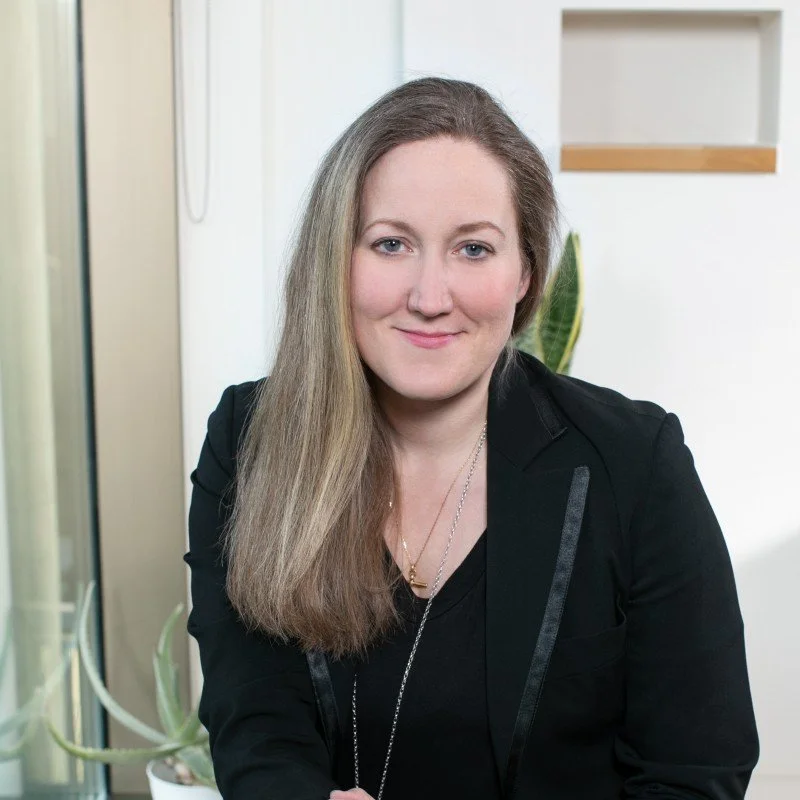
Hi, I’m Jerina.
The boardroom. The hospital ceiling. And everything in between.
I'm a Corporate Affairs Director and experienced Non-Executive Director with board and advisory roles spanning FMCG, biotech, and the charity sector.
My executive career spans two decades of senior leadership in communications and corporate affairs. I've served as Global Head of Communications at Innocent Drinks across 22 markets, led communications strategy at Costa Coffee and Dennis Publishing, and currently sit on the Board at Müller UK & Ireland — one of the UK's largest food and drink businesses.
I'm passionate about high-performing cultures and the belief that the most resilient, effective teams are built from the inside out. The way leaders think about performance, energy, and culture is one of the most underused levers in any organisation. That belief sits at the heart of everything I speak about.
I live in Buckinghamshire with my husband James and children Rupert, 8, Eleanore, 5, and my Hungarian Vizla, Lutley.
“I sat still for a living. And it nearly cost me everything.”
My Story
I have spent two decades building a career I'm proud of. Senior leadership roles at some of the UK's most recognisable brands. A seat at the corporate board table. Non-Executive roles for several successful Start-ups. A team I've built and developed. And alongside all of that — a family. Two young children, a household to run, a coach to local cricket youth team, an active social life.
I was doing everything right. Or so I thought.
I exercised regularly. Ate well. Prioritised my health the way you do when you know how important it is. On paper, I was the person who had it figured out. High-performing at work. Present at home. Ticking every box.
What I hadn't figured out was this: despite the early morning runs, the gym sessions, the clean eating — my working life was spent almost entirely still. In meetings, at my desk, on calls, in cars, on planes. Hours and hours of sitting, every single day. I thought I was active. The truth was I was living in stillness. And stillness, it turns out, has a cost.
One ordinary Monday morning I couldn't get out of bed. The pain that shot down my right leg was electric, absolute, and total. By the time I reached hospital I was crawling on my hands and knees. I was admitted and didn't leave for six weeks.
Six weeks lying flat. My world shrank to the size of one room, then one bed, then the rectangle of ceiling above my head. I got to know every crack in it. I named them — Sally, Bob, Georgia. That ceiling became my entire world.
Two surgeries followed. The second required surgeons to go in through my stomach, with a vascular surgeon present because the risk was that high. The result is permanent metal hardware in my spine. I call myself the bionic woman. I've decided to own it.
But here is what I cannot stop thinking about. This did not have to go this far. The wake-up call didn't have to be that loud.
My Mission
Something is happening in the world that gives me enormous hope — and a burning frustration in equal measure.
A new generation is waking up to movement in a way no generation before them has. Running clubs are the new dating scene. Gym memberships are at record highs. Reformer Pilates has a waiting list. Gen Z understands instinctively that protecting their physical energy is protecting their edge — and they are acting on it in their millions.
And yet the modern workplace has not kept pace. The expectation that performance means presence — that commitment looks like sitting at your desk for long, unbroken hours — remains stubbornly unchanged. The companies that still believe productivity is measured by stillness are not just behind the times. They are actively working against the very people they're trying to get the best from.
That contradiction is what drives me. Because the science is unambiguous. Movement doesn't just protect our health — it sharpens our thinking, fuels our creativity, and builds the kind of sustained resilience that high performance actually requires. The organisations that understand this — and build cultures around it — will be the ones that attract the best people, keep them, and get the very best from them.
The MOVE Method is my answer to that gap. A simple, practical, science-backed framework that I've taken from my own life, into the boardroom, and now onto the stage. Because every leader has the power to change this — and most of them just need someone to show them how.